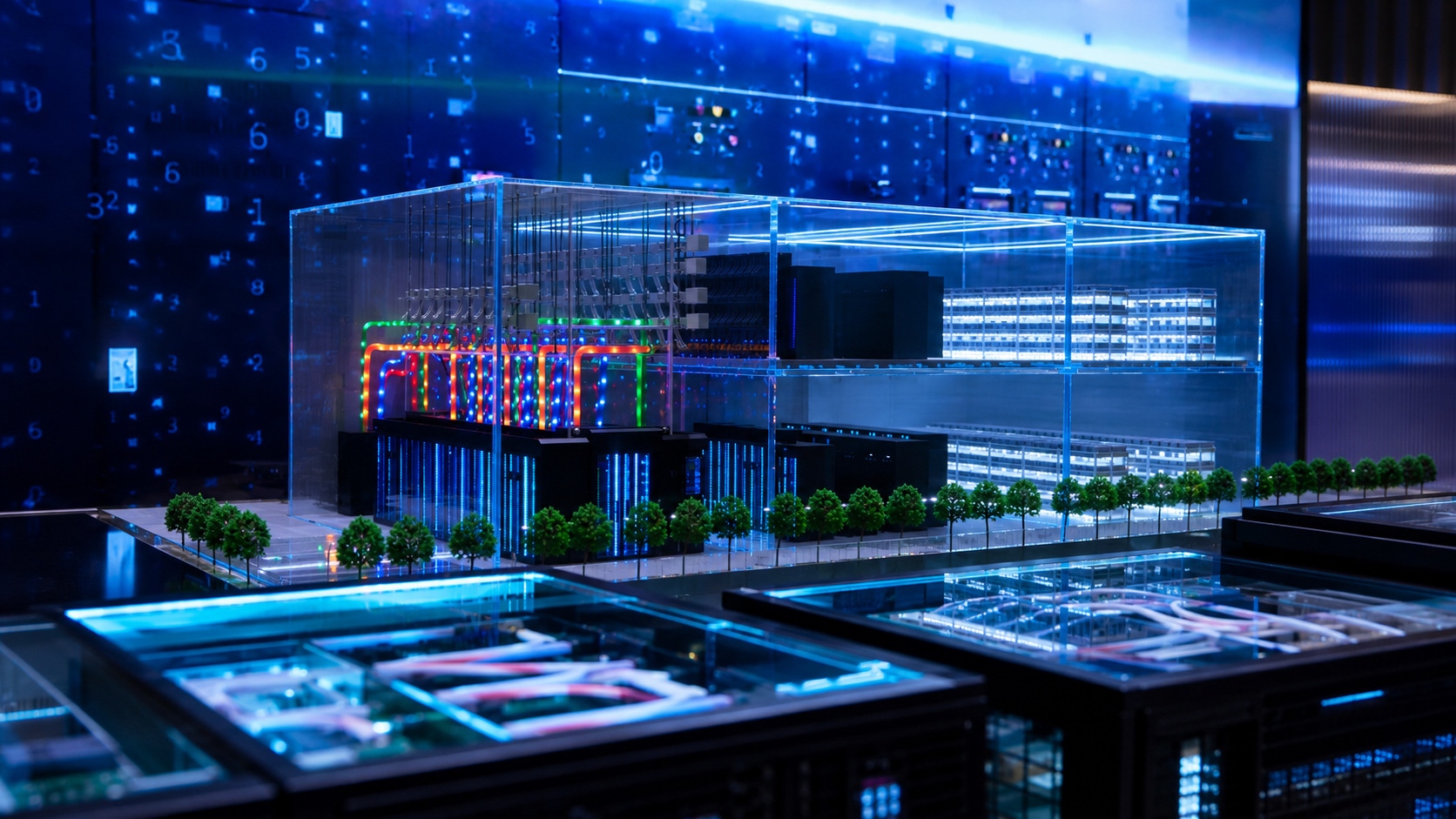
In Hamburg, the future of artificial intelligence stood behind glass. A scale model of a liquid-cooled AI computing factory showed servers, power systems, cooling loops, battery modules, racks, cabling and miniature trees. Above it ran the grand promise: end-to-end service for building the future of AI data centers. Below it sat the physical truth: boards, pipes, connectors, batteries, power paths and cooling. That is what AI looks like once it leaves the slide deck.
For years, the AI debate started with models, prompts and applications. ISC 2026 shifted the frame. AI needs data centers. Data centers need power. Power needs grids. Grids need permits. Racks need cooling. Cooling needs engineering. Engineering needs time. Time decides money. The new economic unit in this world is the token.
Hamburg Turned AI into Industrial Infrastructure
ISC 2026 drew 4,035 attendees from 64 countries and 188 exhibitors from 26 countries. Attendee interest data showed AI applications driven by HPC technologies and AI factories at the top, ahead of data center infrastructure, cooling and quantum computing integration. That order says a lot. Once a company wants an AI factory, it inevitably lands at power, cooling, deployment and infrastructure.
The old supercomputing narrative remains alive. HPC still means science, benchmarks, national ambition and peak performance. AI adds another layer: productive capacity. The question shifts from who has the fastest machine to who can turn compute into useful work at calculable cost. That sounds like manufacturing. The industry is moving there.
TOP500 Preserves the Old Measurement System
The most famous ranking in supercomputing now has a new institutional home. ISC Group is transitioning ownership and publication of the TOP500 list to ACM’s SIGHPC. The list remains free, publicly accessible, announced at ISC and SC, and independent of vendor sponsorship. Its founding authors — Hans Meuer, Erich Strohmaier, Jack Dongarra and Horst Simon — will receive permanent acknowledgement.
The ACM/SIGHPC presentation describes TOP500 as a critical component of the international HPC community across industry, government and academia. It calls the list the primary measurement system for leadership in HPC around the world. Governments, researchers and companies use it to compare status, track progress and describe a country’s position in the field.
That still matters. A number can organize a field. A ranking creates comparison. It turns compute capacity into political language. It also preserves history: follow the lists since 1993 and you see architectures, nations, labs, vendors and accelerators rise and fall.
Yet a second ranking is emerging inside companies. It measures utilization, energy per result, cost per token, latency, output quality, operational stability and time to productive use. TOP500 shows who can compute. The new internal table shows who can turn compute into value.
The Token Loses Its Crypto Drama
A few years ago, the word token carried a different burden. In 2018, the media platform Civil tried to fund journalism through blockchain tokens. The sale missed its $8 million minimum by a wide margin and raised less than $2 million from a little over 600 people.
The buying process became its own barrier. Nieman Lab described the entry into Civil’s blockchain future as a 44-step journey through wallets, browser plugins, Ethereum, identity checks, multiple services and waiting loops. For broad media funding, that was fatal friction.
The AI token of 2026 works differently. It needs no wallet. It carries no speculative promise. It appears whenever a model works. An answer costs tokens. A summary costs tokens. An agent run costs tokens. A code correction costs tokens. The token becomes the unit count of AI production.
OpenAI prices API usage per million tokens and separates input, cached input and output tokens. Prompt caching can reduce both latency and input cost for repeated content. That pricing structure makes the new economics visible at a granular level.
Darren Cox Talks About the Clock
Darren Cox, General Manager of KAYTUS, frames the bottlenecks of this economy in practical terms: deployment time, utilization and energy.
Many AI clusters take 18 to 24 months before they reach productive operation. During that time, the market moves. Models change. Applications change. Competitors automate. Capital is tied up before the first productive token is generated.
At ISC 2026, KAYTUS presented a prefabricated, liquid-cooled AI factory architecture. It starts with a 3 MW delivery unit, scales up to 1 GW, and is designed to cut deployment timelines by up to 60 percent compared with conventional data center construction. Its standardized modules are called IT Cube, Power Cube and Cooling Cube.
Cox turns that architecture into a simple business logic: the facility pays off once it generates tokens that create revenue or operational value. The cluster itself is tied-up capital. The tokens are the product.
Utilization Eats the Margin
Cox points to a gap that many AI strategies prefer to ignore. Leading providers, in his view, reach utilization levels of 70 to 80 percent. Smaller providers, start-ups and many organizations often remain between 15 and 30 percent.
That gap decides profit or loss. A poorly utilized cluster still consumes electricity, cooling, space, maintenance, staff time and depreciation. The accelerator does not wait for free. It ages. It ties up money. It needs operators.
In traditional IT, spare capacity could function as a safety buffer. In AI production, idle high-end hardware becomes a cost trap. Expensive accelerators need productive load. Productive load needs data, applications, software tuning, model selection and demand. The new metric is usable tokens under real operating conditions.
Power Redraws the Location Map
The second limit sits at the power connection. Cox talks about racks reaching up to 250 kilowatts. Many conventional data centers were never designed for such power densities. AI compresses power, heat and capital into very little space.
The International Energy Agency expects global data center electricity consumption to rise from 485 TWh in 2025 to 950 TWh in 2030. Electricity use by AI-focused data centers is projected to triple over that period.
For Europe, this becomes a location issue. AI factories need grid connections, substations, cooling technology, power electronics, sites, maintenance teams and energy contracts. AI capacity competes with industry, housing, electrified mobility and heating systems for grid access and planning capacity.
The EU’s Energy Efficiency Directive already requires reporting on the energy performance of data centers. This fits the new reality: compute capacity is becoming a measurable part of industrial policy.
Containers Shorten the Construction Site
KAYTUS is betting on prefabrication. Parts of the data center are assembled, cabled, tested, packed and shipped before they reach the site. In the more radical version, a complete building block arrives as a container. Work moves from the unpredictable construction site into a controlled factory process.
A container does not solve the energy problem without a grid connection. It does not remove the need for permits. It can reduce installation time, interface risk and on-site complexity. In an industry where models and markets change faster than construction projects, that time gain matters.
In Cox’s framing, 18 to 24 months can shrink to a few months. That changes the business case. The time to the first productive token gets shorter. Capital starts working earlier.
The Mittelstand Needs Token Controlling
Most mid-sized companies will never build their own gigawatt-scale AI factory. The token economy will still reach them. A service chatbot, a technical document search system, an automated quoting tool, a development assistant and an agent in procurement all consume tokens. Every transaction has a cost. Management needs to ask a practical question: which task deserves which model?
A simple classification task does not need an expensive frontier model. A complex technical analysis needs context, data access, rights management and quality control. An agent that calls multiple tools, searches documents and produces long answers can become more expensive than its value.
The cloud invoice turns into a production bill. Inputs, outputs, caching, latency and model choice belong in the calculation. The Mittelstand does not need another buzzword. It needs controlling.
Cost per process. Model choice by task. Data access by workflow. Short outputs where short outputs suffice. Local systems for sensitive data. Cloud models for flexible workloads. Measurement before enthusiasm.
Corporations Pull Compute Closer to Value Creation
Large companies will want to control parts of their AI infrastructure more directly. Automakers need models for simulation, software, quality and service. Chemical companies work on materials and process development. Banks examine documents, risks and fraud. Insurers automate claims processes. Media companies accelerate research, distribution and archive access. Hospitals need privacy, traceability and reliability. In each case, the result must be priced.
What does a customer answer cost? What does a risk analysis cost? What does a software suggestion cost? What does a maintenance recommendation cost? Which answer creates revenue? Which one saves time? Which one merely shifts work into expensive compute?
Traditional IT procurement asked about licenses, servers and support. AI procurement asks about tokens, utilization, latency, data risk, energy and process value.
The Hamburg Images Show the New Reality
The pictures from the show floor capture the shift better than many strategy slides. Behind acrylic glass sit battery modules, power paths, servers, cooling lines and racks. Blue light cuts through transparent walls. Tiny model trees stand in front of a miniature data center landscape. It almost looks playful. The message is hard: AI requires industrial construction.
The battery cube shows that power buffering and load management become part of the architecture. The boards under glass show that every model meets hardware. The illuminated lines show that cooling has become central. The phrase “Liquid Cooling AI Computing Factory” gets the category right. AI is built, powered, cooled, operated and measured.
The Next AI Strategy Starts with the Bill
ISC 2026 brought several lines together. TOP500 preserves the public memory of high-performance computing. AI factories shift attention toward productive AI capacity. KAYTUS shows how vendors want to industrialize the build-out of that capacity. The token economy turns usage into unit cost. The energy question forces companies and policymakers into location planning.
The old promise of effortless digital scaling does not carry far here. AI is heavy. It needs concrete, copper, fiber, chips, coolant, energy contracts, technicians, monitoring and capital. Its output appears in a chat window. Its cost is created in the data center.
Hamburg showed the next phase of AI: less wonder at the answer, more work on how the answer is produced. Any company that wants to use AI economically must learn to count. Tokens per watt. Tokens per euro. Tokens per hour. Tokens per process. The machines get larger. The time windows get shorter. Power gets scarcer. The token becomes the unit count.
 www.ne-na.me
[…] AI Gets a Bill of Materials […]