
The killer, this time, was light. It gleamed on the stage of the Rheinbach College of Glass, ran along the smooth edge of a handmade dagger, and struck the audience with something sharper than irony. No blood, no body—just applause. Yet murder hung in the air.
The occasion was the presentation of the Rheinbach Glass Dagger, an award as beautiful as it is impractical, to Ann Cleeves, queen of British crime fiction, creator of Vera Stanhope and Jimmy Perez. A weapon, yes—but one that only kills with reflection.
A Scene Set in Glass
Headmaster Jochen Röbers opened the evening with the calm of a man used to working with fire. He spoke about his students, their glassworks, their exhibition, and the curious risk of appearing in the event’s livestream. Then he handed the floor to David Eisermann, the host, a cultural journalist with the mischievous precision of someone who knows how to make writers talk. “Glass Dagger,” he quipped, “sounds a bit like Game of Thrones, doesn’t it?”
The audience laughed. A wise move. Moments later, they would fall silent before a woman whose characters rarely survive the prologue.
The Woman Who Listens to Silence
Ann Cleeves does not perform. She speaks quietly, with that British understatement that is both armour and style. “I wanted Jimmy Perez to be a little happier,” she says, “maybe even funny. After eight books, a man deserves that.”

Then she begins to read. No introduction, no scene-setting. Just storm.
From the prologue of The Killing Stones: Archie Stout shouts into the darkness; the wind swallows his voice; a torchlight vanishes. “Ah,” he says, “so it’s you.” And that’s that.
Cleeves reads like a coroner filing her report—no sentiment, no suspenseful pause. Her voice is clear, almost kind, which makes the cruelty of her sentences all the more chilling.
Return of the Shetland Man
Next she reads the opening of Chapter One: Willow Reeves, now living with Jimmy Perez, returns home by ferry through the Orkney fog. She finds the house empty, a note on the table: Archie Stout is missing and Veyra is frantic. I managed to get a boat to Westray.
“That’s all it takes,” Cleeves says afterward. “A line like that—and everything starts to fall apart.” It sounds less like an explanation than a confession.
Birdwatching and Murder
Eisermann leans forward. “How did you end up on these islands in the first place?”
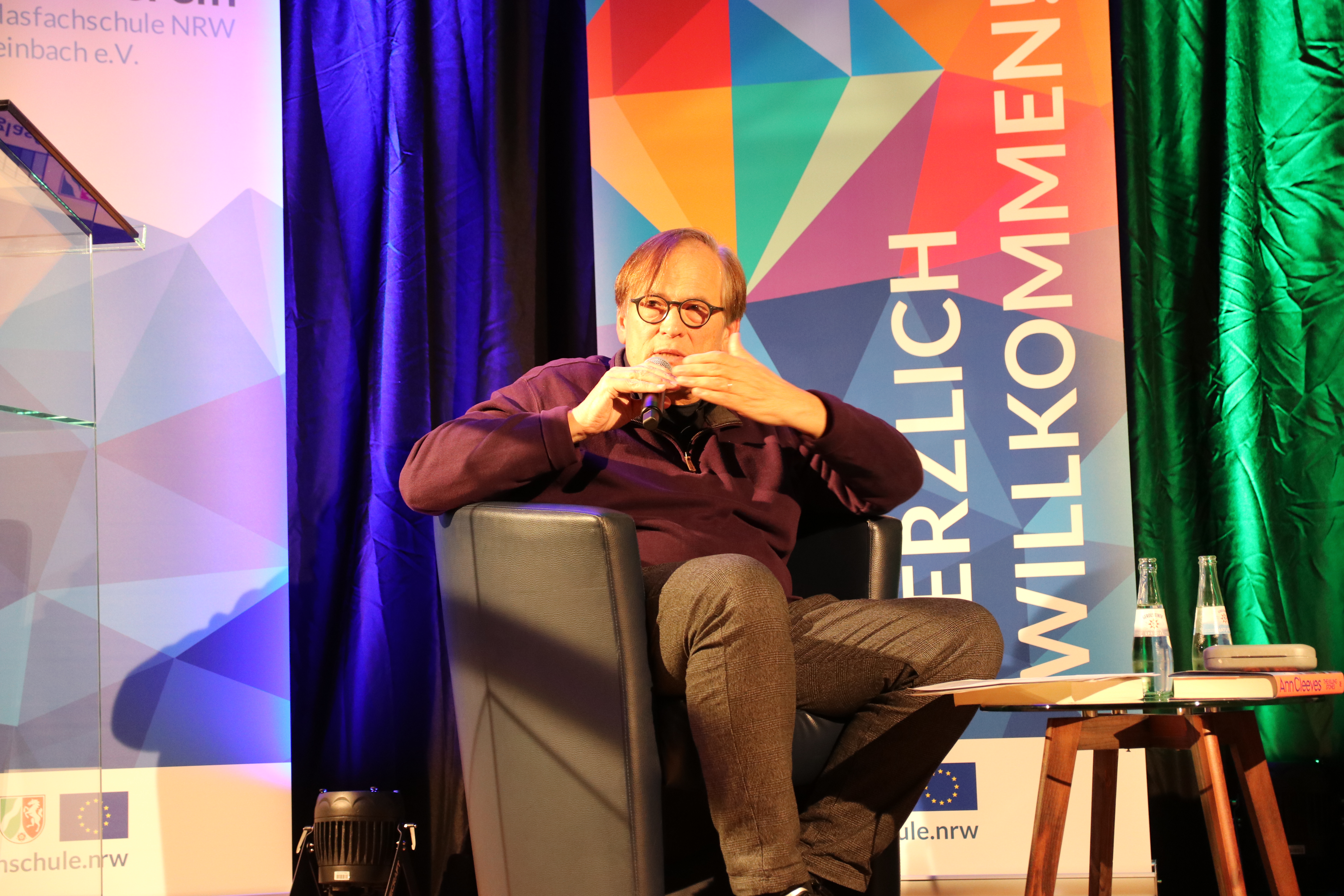
“I ran away,” she says. “Fifty years ago, I dropped out of university and worked as a cook at the bird observatory on Fair Isle. Not a very good cook—but I learned to listen.”
She married one of the birdwatchers who came to the island. “If you can stand in a storm for hours waiting for a rare bird, you’ve got the patience to write a book.” It is the most perfect sentence of the night—part joke, part ars poetica.
The Weight of the Stones
Cleeves talks about Orkney—about burial mounds, wind, and the Viking graffiti carved inside ancient tombs. “The runes were filthy,” she says. “Very smutty. Just like teenage boys.” The audience laughs. She doesn’t.
In The Killing Stones, she imagined two carved stones—the so-called Story Stones—with inscriptions that sum up her whole philosophy: I am Olaf, teller of tales. Hear my stories and know death.
“I thought that sounded mythic,” she says. “I will tell you—and you will learn to know death.”
No irony, no exaggeration. It’s not a joke; it’s her definition of storytelling. Writing, for Cleeves, is how one survives proximity to the void.
Writing as Alibi
“How do you work?” Eisermann asks. “From nine to five?”
“Oh no,” she replies, “if you only wrote on creative days, you’d never write.”
She never plots in advance. “I start with an image, or a sentence. I write like a reader—I want to find out what happens next.”
The audience nods. They know: that’s why her books breathe. Because she writes to discover, not to explain.
Vera, Jimmy and the Power of Place
Later she talks about Vera, played by the Oscar-nominated Brenda Blethyn. “Brenda read all the books, not just the scripts,” she says. “If a writer made Vera do something she wouldn’t, Brenda would text me: Our Vera would never do that.”
It’s British quality control—fierce, loyal, and polite.
The Shetland TV series, she adds, has increased tourism to the islands by nearly fifty percent. “Not sure if that’s a good thing,” she says. “Now it’s harder to find a quiet place to kill someone.” The room bursts out laughing.
The Dagger
Then comes the moment. Winrich C.-W. Clasen, publisher and founder of the award, steps forward with the dagger in his hands—clear, elegant, fatal in theory only. “A perfect crime,” he says, “committed in glass.”
Cleeves examines it under the light. “I think you could actually kill someone with that,” she says. “I just don’t know what customs will think when I fly home.”
A line worthy of her own detective.
After the Crime
Later she signs books, smiles, chats with students from the glass design programme. No fuss, no fame. Just the quiet composure of a woman who has long known how to turn chaos into narrative order.
“We tell stories,” she says, “because the world is messy. In fiction, at least, justice can still happen.”
The glass dagger gleams under the stage lights—cool, transparent, flawless. A murder weapon that kills nothing but uncertainty.
Siehe auch:
 www.ne-na.me
[…] The Elegance of Killing – Ann Cleeves and the Glass Dagger of Rheinbach @AnnCleeves […]